Get Retroactive on macOS and Linux Now!
Run Aperture, iPhoto, and iTunes on macOS Golden Gate, macOS Tahoe, macOS Sequoia, macOS Sonoma, macOS Ventura, macOS Monterey, macOS Big Sur, and macOS Catalina. Xcode 11.7 on macOS Mojave. Final Cut Pro 7, Logic Pro 9, and iWork ’09 on macOS Mojave or macOS High Sierra
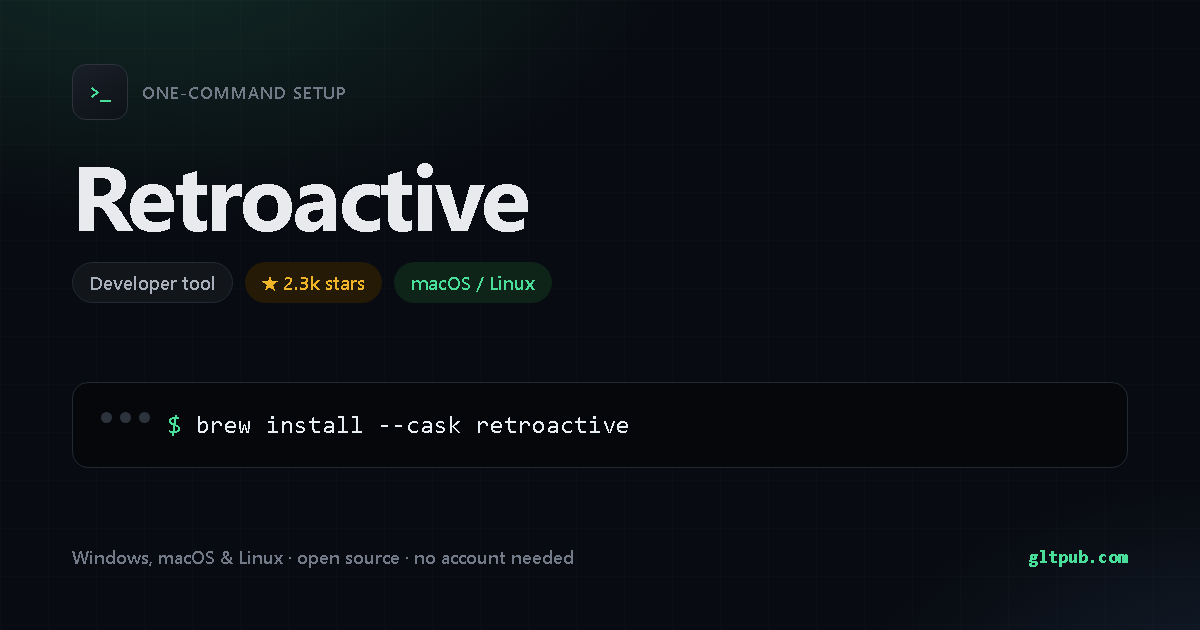
Get Retroactive with one command
Pick your system, reveal the step-by-step guide, copy the command, paste it into your terminal and press Enter. This command comes from the project's public source.
Not available for Windows yet.
Retroactive doesn't publish an install command for Windows anywhere we can verify, so there's nothing for us to show you. We won't invent one. It does document one for macOS and Linux — switch to that tab.
Pastes into PowerShell and installs Retroactive on your Windows machine in one step. Runs as your normal user account, and needs no administrator rights.
Not available for macOS yet.
Retroactive doesn't publish an install command for macOS or Linux anywhere we can verify, so there's nothing for us to show you. We won't invent one.
Installs Retroactive on your macOS or Linux machine and links it into your PATH — after this,
Retroactive just works from any directory. Runs as your normal user account, and needs no administrator rights.
How to set up Retroactive, step by step
Open Terminal. On a Mac it's in Applications ▸ Utilities, or press Cmd+Space and type Terminal. On Linux, press Ctrl+Alt+T. Paste the command and press Enter.
Run Retroactive --help to see the available commands, and
Retroactive --version to confirm the install worked. If your shell complains about
permissions, that project usually documents a corrected command on its own site.
This asks Homebrew to fetch Retroactive and link it into /opt/homebrew/bin (Apple Silicon) or /usr/local/bin (Intel), so you can run it by name.
About Retroactive
To open Retroactive, navigate to System Settings > Privacy & Security, then scroll down and click “Open Anyway”
From Retroactive's own README.
About Retroactive
Run Aperture, iPhoto, and iTunes on macOS Golden Gate, macOS Tahoe, macOS Sequoia, macOS Sonoma, macOS Ventura, macOS Monterey, macOS Big Sur, and macOS Catalina. Xcode 11.7 on macOS Mojave. Final Cut Pro 7, Logic Pro 9, and iWork ’09 on macOS Mojave or macOS High Sierra
| Category | Developer tool |
|---|---|
| Install method | Homebrew |
| Windows | no install command published |
| macOS / Linux | documented install command available |
| Price | Free and open source |
| Command verified | From project source |
| Popularity | 2.3k stars on the project's public repository |
On mobile
Retroactive is a command-line tool, so there is no phone app for it — a phone has no shell to run it in. You'll need a desktop, or a remote shell into a machine that has one.
Retroactive is developed by its own authors. This page is an independent reference; we are not affiliated with or sponsored by the project. The command shown here was reproduced from the project's public documentation — always check the project's own documentation before running anything.