Get conductor on Windows, macOS or Linux Now!
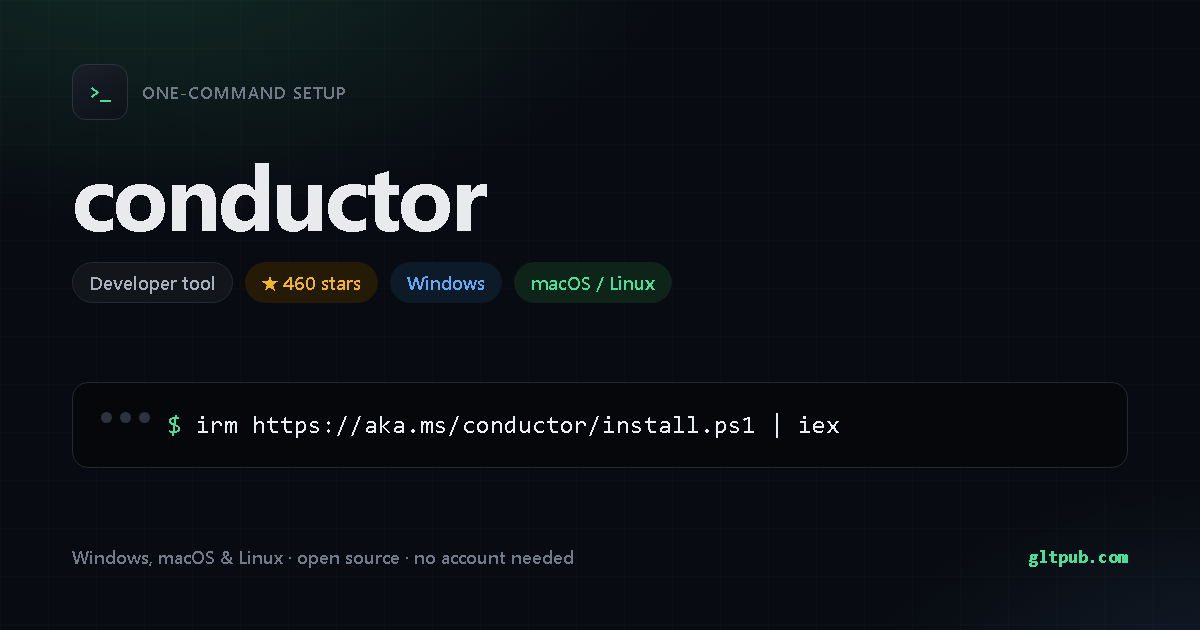
Get conductor with one command
Pick your system, reveal the step-by-step guide, copy the command, paste it into your terminal and press Enter. This command was taken from the project's own documentation and checked against it.
Not available for Windows yet.
conductor doesn't publish an install command for Windows anywhere we can verify, so there's nothing for us to show you. We won't invent one. It does document one for macOS and Linux — switch to that tab.
Pastes into PowerShell and installs conductor on your Windows machine in one step — no manual setup, no build tools. It fetches the project's own install script and runs it, which is the standard way these tools ship — worth a read if you like to know what's running.
Not available for macOS yet.
conductor doesn't publish an install command for macOS or Linux anywhere we can verify, so there's nothing for us to show you. We won't invent one. It does document one for Windows — switch to that tab.
Pastes into your terminal and installs conductor on your macOS or Linux machine in one step — no manual setup, no build tools. It fetches the project's own install script and runs it, which is the standard way these tools ship — worth a read if you like to know what's running.
How to set up conductor, step by step
On Windows, open PowerShell (press Win, type PowerShell, hit Enter) and paste the command. On macOS or Linux, open Terminal — on a Mac it's in Applications ▸ Utilities, or press Cmd+Space and type Terminal — and paste the command there.
Run conductor --help to see the available commands, and
conductor --version to confirm the install worked. If your shell complains about
permissions, that project usually documents a corrected command on its own site.
This asks PowerShell to download a small installer script from the project, then execute it in memory. Nothing is saved to disk. The script is the project's own, but it's worth reading it first — that's why there's a note above.
What conductor does
- Parallel execution - Run agents concurrently (static groups or dynamic for-each)
- Sub-workflow composition - Reusable sub-workflows with templated, usable inside groups for dynamic fan-out
- Script steps - Run shell commands and route on exit code or parsed JSON stdout
- MCP steps - Call MCP server tools directly without an LLM (deterministic execution, zero prompt tokens, and structured envelope routing)
- Reasoning effort - Unified (low/medium/high/xhigh/max) per agent or workflow-wide, translated to each provider's native API
- Workspace instructions - Auto-discover and inject / / into every agent's prompt
Summarised from conductor's own README.
About conductor
conductor is an open-source developer tool.
| Category | Developer tool |
|---|---|
| Install method | PowerShell one-liner (irm | iex) |
| Windows | documented install command available |
| macOS / Linux | documented install command available |
| Price | Free and open source |
| Command verified | Yes — checked against the project README |
| Popularity | 460 stars on the project's public repository |
On mobile
conductor is a command-line tool, so there is no phone app for it — a phone has no shell to run it in. You'll need a desktop, or a remote shell into a machine that has one.
conductor is developed by its own authors. This page is an independent reference; we are not affiliated with or sponsored by the project. The command shown here was reproduced from the project's public documentation — always check the project's own documentation before running anything.