Get kdash on Windows, macOS or Linux Now!
A simple and fast dashboard for Kubernetes
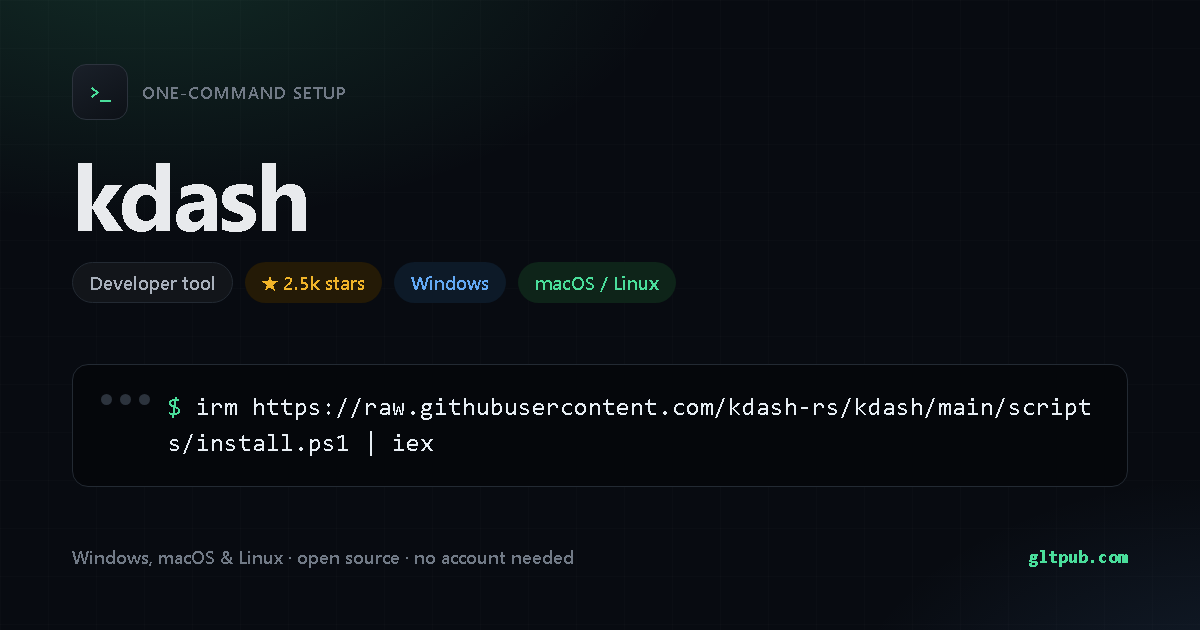
Get kdash with one command
Pick your system, reveal the step-by-step guide, copy the command, paste it into your terminal and press Enter. This command was taken from the project's own documentation and checked against it.
Not available for Windows yet.
kdash doesn't publish an install command for Windows anywhere we can verify, so there's nothing for us to show you. We won't invent one. It does document one for macOS and Linux — switch to that tab.
Pastes into PowerShell and installs kdash on your Windows machine in one step — no manual setup, no build tools. It fetches the project's own install script and runs it, which is the standard way these tools ship — worth a read if you like to know what's running.
Not available for macOS yet.
kdash doesn't publish an install command for macOS or Linux anywhere we can verify, so there's nothing for us to show you. We won't invent one. It does document one for Windows — switch to that tab.
Pastes into your terminal and installs kdash on your macOS or Linux machine in one step — no manual setup, no build tools. It fetches the project's own install script and runs it, which is the standard way these tools ship — worth a read if you like to know what's running.
How to set up kdash, step by step
- Press Win+R to open the Run dialog.
- Press Ctrl+V to paste the command you just copied.
- Press Enter. A PowerShell window will flash; the installer runs.
The command fetches the project's own installer, marks it unblocked, and runs it from memory. You do not need to save the file. If Windows asks "Do you want to allow this app to make changes?", click Yes — the installer needs to add itself to your PATH.
What kdash does
- Built-in themes include Catppuccin Macchiato/Latte, Gruvbox Dark, Solarized Dark, and Mono, plus an optional custom theme, cycled at runtime with /
- Live resource watch polls and refreshes Kubernetes resources at a configurable interval ( flag)
- Custom resource definitions are discovered and browsable alongside built-in kinds
- Describe and YAML views for any resource, with syntax highlighting and copy to clipboard
- Deep drill-down navigation moves from workloads to owned Pods, from Pods to Containers, and from Nodes to the Pods scheduled on them
- Shell into a container from the Containers view. KDash suspends the UI while the shell is active and restores it when you exit
Summarised from kdash's own README.
About kdash
A simple and fast dashboard for Kubernetes
| Category | Developer tool |
|---|---|
| Install method | PowerShell one-liner (irm | iex) |
| Windows | documented install command available |
| macOS / Linux | documented install command available |
| Price | Subscription plans from $9/mo · free Starter tier · team and enterprise plans |
| Command verified | Yes — checked against the project README |
| Popularity | 2.5k stars on the project's public repository |
On mobile
kdash is a command-line tool, so there is no phone app for it — a phone has no shell to run it in. You'll need a desktop, or a remote shell into a machine that has one.
kdash is developed by its own authors. This page is an independent reference; we are not affiliated with or sponsored by the project. The command shown here was reproduced from the project's public documentation — always check the project's own documentation before running anything.