Get microclaw on Windows, macOS or Linux Now!
Open-source developer tool with a documented one-command setup.
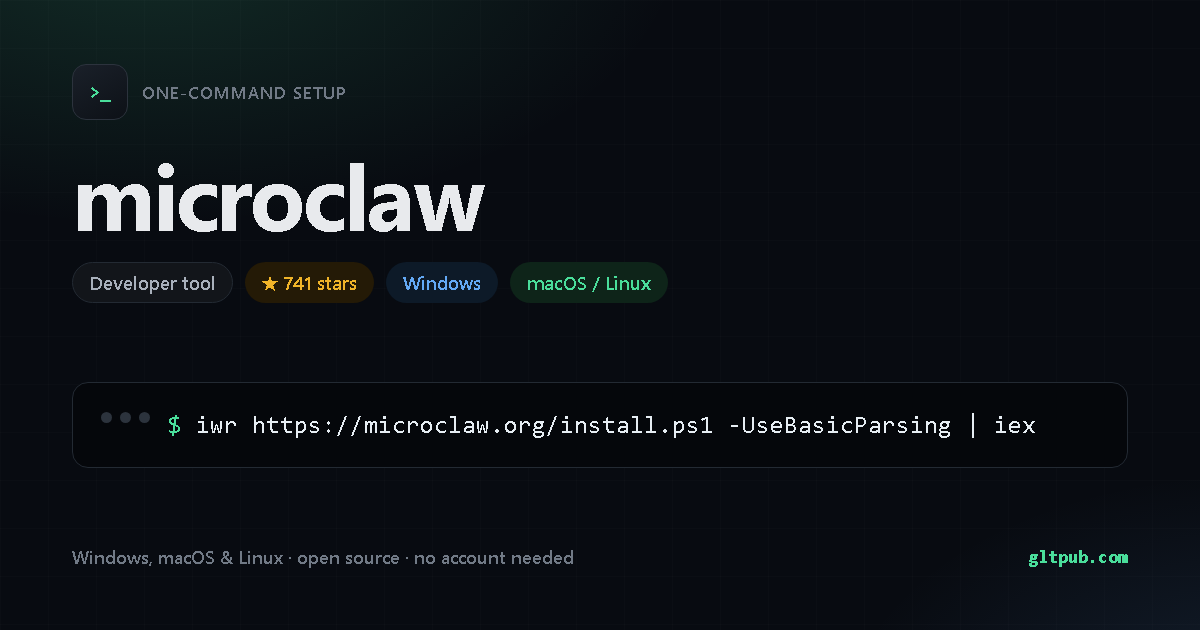
Get microclaw with one command
Pick your system, reveal the step-by-step guide, copy the command, paste it into your terminal and press Enter. This command was taken from the project's own documentation and checked against it.
Command not yet published for this platform.
The directory is a work in progress; the project's own docs have the most up-to-date install instructions. We will not invent one.
Pastes into PowerShell and installs microclaw on your Windows machine in one step — no manual setup, no build tools. It fetches the project's own install script and runs it, which is the standard way these tools ship — worth a read if you like to know what's running.
Command not yet published for this platform.
The directory is a work in progress; the project's own docs have the most up-to-date install instructions. We will not invent one.
Pastes into your terminal and installs microclaw on your macOS or Linux machine in one step — no manual setup, no build tools. It fetches the project's own install script and runs it, which is the standard way these tools ship — worth a read if you like to know what's running.
How to set up microclaw, step by step
- Press Win+R to open the Run dialog.
- Press Ctrl+V to paste the command you just copied.
- Press Enter. A PowerShell window will flash; the installer runs.
- Press Cmd+Space to open Spotlight.
- Type Terminal and press Enter to launch Terminal.
- Press Cmd+V to paste the command you just copied.
- Press Enter. The installer runs and finishes within a few seconds.
The command fetches the project's own installer, marks it unblocked, and runs it from memory. You do not need to save the file. If Windows asks "Do you want to allow this app to make changes?", click Yes — the installer needs to add itself to your PATH. On macOS, if the system blocks the script, open System Settings › Privacy & Security and click "Open Anyway" next to the blocked entry.
What microclaw does
- One core, two product surfaces. Server and Work share the same Agent Engine, provider layer, tools, memory, policy, and recovery model
- Execution that can continue. Sessions, safe tool boundaries, scheduled work, and outbound delivery survive process restarts
- Provider freedom. Use native Anthropic or a broad set of OpenAI-compatible and local providers through one internal message model
- Safety is part of execution. Tool risk gates, scoped grants, egress controls, sandboxing, redaction, and audit trails use shared enforcement points
- Resume session state and load relevant memory, skills, and runtime context
- Call the selected model using provider-neutral messages and tool definitions
Summarised from microclaw's own README.
About microclaw
Open-source developer tool with a documented one-command setup.
| Category | Command-line tool |
|---|---|
| Install method | PowerShell one-liner (irm | iex) |
| Windows | documented install command available |
| macOS / Linux | documented install command available |
| Price | Subscription plans from $9/mo · free Starter tier · team and enterprise plans |
| Command verified | Yes — checked against the project README |
| Popularity | 741 stars on the project's public repository |
On mobile
microclaw is a command-line tool, so there is no phone app for it — a phone has no shell to run it in. You'll need a desktop, or a remote shell into a machine that has one.
microclaw is developed by its own authors. This page is an independent reference; we are not affiliated with or sponsored by the project. The command shown here was reproduced from the project's public documentation — always check the project's own documentation before running anything.