Get plannotator on Windows, macOS or Linux Now!
Open-source developer tool with a documented one-command setup.
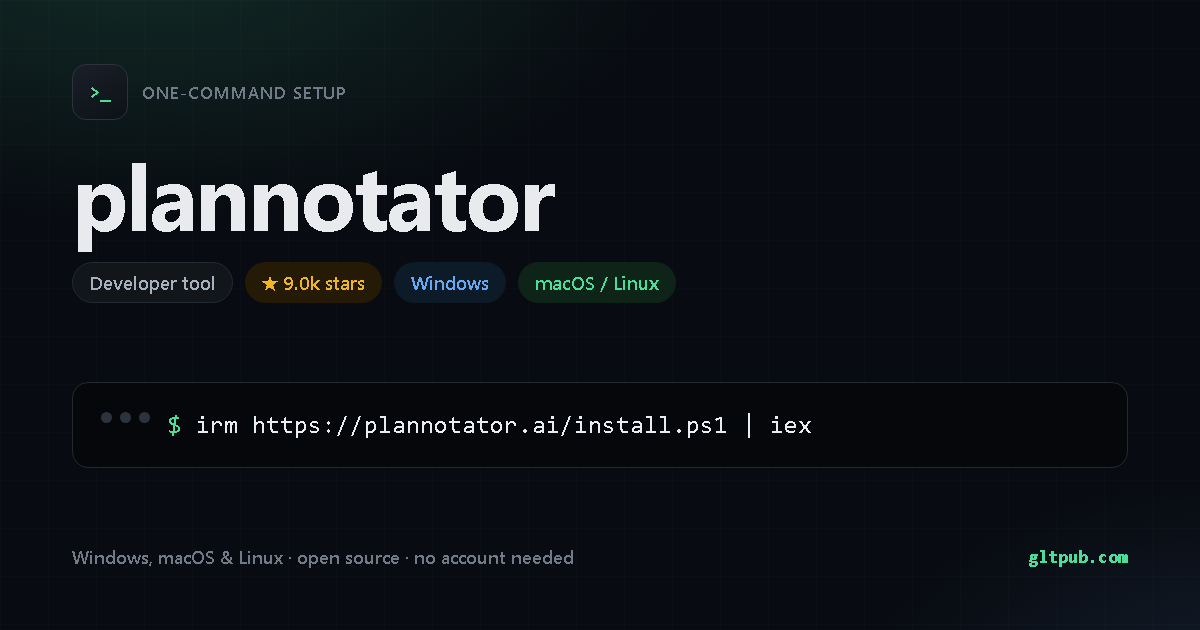
Get plannotator with one command
Pick your system, reveal the step-by-step guide, copy the command, paste it into your terminal and press Enter. This command was taken from the project's own documentation and checked against it.
Command not yet published for this platform.
The directory is a work in progress; the project's own docs have the most up-to-date install instructions. We will not invent one.
Pastes into PowerShell and installs plannotator on your Windows machine in one step — no manual setup, no build tools. It fetches the project's own install script and runs it, which is the standard way these tools ship — worth a read if you like to know what's running.
Command not yet published for this platform.
The directory is a work in progress; the project's own docs have the most up-to-date install instructions. We will not invent one.
Pastes into your terminal and installs plannotator on your macOS or Linux machine in one step — no manual setup, no build tools. It fetches the project's own install script and runs it, which is the standard way these tools ship — worth a read if you like to know what's running.
How to set up plannotator, step by step
- Press Win+R to open the Run dialog.
- Press Ctrl+V to paste the command you just copied.
- Press Enter. A PowerShell window will flash; the installer runs.
- Press Cmd+Space to open Spotlight.
- Type Terminal and press Enter to launch Terminal.
- Press Cmd+V to paste the command you just copied.
- Press Enter. The installer runs and finishes within a few seconds.
The command fetches the project's own installer, marks it unblocked, and runs it from memory. You do not need to save the file. If Windows asks "Do you want to allow this app to make changes?", click Yes — the installer needs to add itself to your PATH. On macOS, if the system blocks the script, open System Settings › Privacy & Security and click "Open Anyway" next to the blocked entry.
What plannotator does
- URL annotation fetches the requested site, through Jina Reader by default for public pages or directly when Jina is disabled or unavailable
- GitHub and GitLab review uses your authenticated CLI and Git remote to retrieve PR or MR data
- Ask AI and review agents send the selected question and relevant plan, document, repository, or diff context to your configured provider
- Sharing sends the complete link to whoever or whatever service you use to deliver it. Encrypted short links upload ciphertext to the paste service
- Workspaces is a separate hosted product, so the open source app's local-storage model does not apply to content placed there
Summarised from plannotator's own README.
About plannotator
Open-source developer tool with a documented one-command setup.
| Category | Command-line tool |
|---|---|
| Install method | PowerShell one-liner (irm | iex) |
| Windows | documented install command available |
| macOS / Linux | documented install command available |
| Price | Subscription plans from $9/mo · free Starter tier · team and enterprise plans |
| Command verified | Yes — checked against the project README |
| Popularity | 9.0k stars on the project's public repository |
On mobile
plannotator is a command-line tool, so there is no phone app for it — a phone has no shell to run it in. You'll need a desktop, or a remote shell into a machine that has one.
plannotator is developed by its own authors. This page is an independent reference; we are not affiliated with or sponsored by the project. The command shown here was reproduced from the project's public documentation — always check the project's own documentation before running anything.